Facts & Fiction
Stories Stripped Away By Book Bans
Key Findings:
44% of banned titles feature characters or people of color, the largest percentage ever in this category;
29% are nonfiction, including an astonishing range of informational books and textbooks;
Despite claims of “pornography,” only 10% of banned titles included “on the page” consensual sexual experiences.
PEN America Experts:
Senior Advisor, Freedom to Read
Program Manager, Freedom to Read

Program Assistant, Freedom to Read

Director, Freedom to Read
The freedom to read and learn, and the right to access information, ideas, and knowledge, is among the most fundamental building blocks of a democratic society. When books are removed from schools and banned from students’ reach in libraries and classrooms, bedrock civil and human rights are violated. The content of these books that are disappearing speaks volumes both about the stories, identities, and facts that are being suppressed and about the political and cultural attack on public education across the United States. That attack on public education restricts the freedom to read for young people of this country, hindering their ability to see themselves and others, be challenged, and explore their worlds.
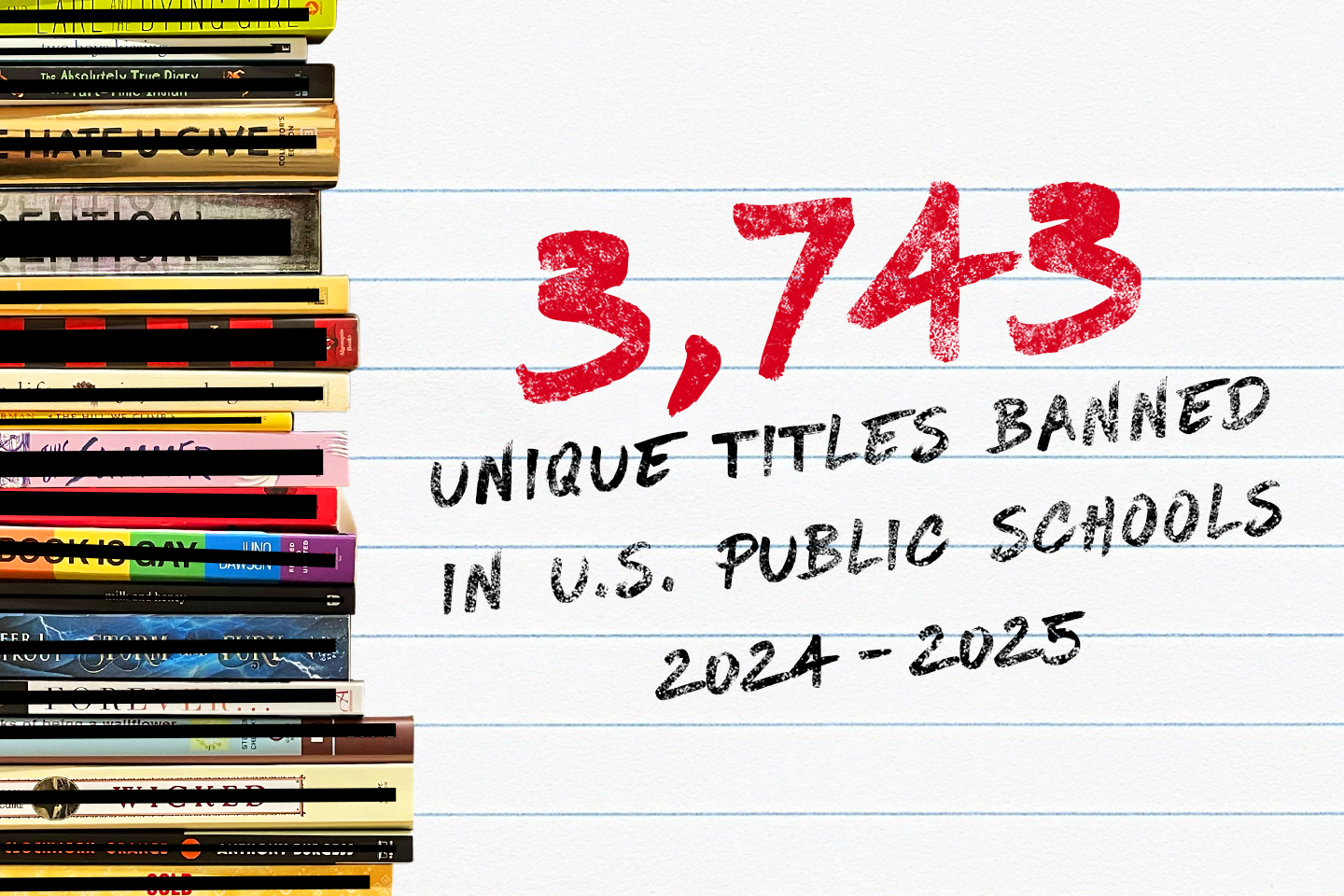
Since 2021, PEN America has documented the magnitude of school book bans and illuminated the normalization of educational censorship in everyday American life. Our research analyzing the content of the thousands of books banned over the past five years has consistently highlighted the effort to purge stories and books that discuss race and racism, LGBTQ+ people or characters, people or characters of color, and sex from our nation’s schools. This report extends these findings, examining the content of 3,743 unique titles banned during the 2024-2025 school year and how these trends are evolving.
3743
Unique titles banned during the 2024-2025 school year
Namely, in the last school year, we found a surge in the banning of nonfiction titles. We documented bans on over 1,100 unique titles that are educational or informational books for young people—textbooks or reference texts on a wide range of subjects, history books, biographies, and autobiographies. This marked impact on books anchored in scientific and historic facts, real events, and real people represents something new and distinctive about the trajectory of book bans in public schools. As nonfiction titles are not always the targets of efforts to remove books, that books on ancient Egypt, the digestive system, and self-help for teens, to name a few examples, are impacted by censorship signals an alarming spread of book bans that ignore the educational value of texts and books.
Book bans are a bellwether of broader societal trends. Since 2021, book bans have reflected backlash, at times coordinated, against the mainstream acceptance of LGBTQ+ people, efforts to reckon with the country’s history of racism and inequality, and increased comfort with open discussion of sex and sexuality. For books banned in the 2024-2025 school year, a strain of anti-intellectualism, as illustrated in bans on nonfiction titles, also mirrors the broader political attack on facts and knowledge and the skepticism and devaluation of, and disdain for, experts and expertise—tactics long associated with the rise of authoritarian regimes and intended to sow distrust in democratic institutions.
At a time when faith in public institutions is in jeopardy, doubt in expertise and education is on the rise, and our literacy rates are on a decline, we should be making it easier to access in schools literature that is both relatable and educational. When we limit the kinds of books that can be accessed in schools and ban certain stories from our libraries, we corrode diverse and inclusive learning environments that reflect the identities of all learners. The absence of these books limits the perspectives students can engage with and learn from, sends harmful messages about belonging and equality, and erodes the freedom to read and think. And while this censorship continues to be sweeping, so too are its effects, ultimately impacting all of us.
Nonfiction Bans and the Spread of Anti-Intellectualism
I believe that censorship grows out of fear, and because fear is contagious, some parents are easily swayed. Book banning satisfies their need to feel in control of their children’s lives. This fear is often disguised as moral outrage. They want to believe that if their children don’t read about it, their children won’t know about it. And if they don’t know about it, it won’t happen.
Judy Blume, Author
Understanding the profound impact of book bans starts with understanding the kinds of books banned. The majority of titles removed (79%) were developed and written for children and young people. During the 2024-2025 school year, over half of all unique banned titles were young adult books (57%), followed by adult literature (20%). The remaining 22% of all banned titles included middle grade, chapter, and picture books.
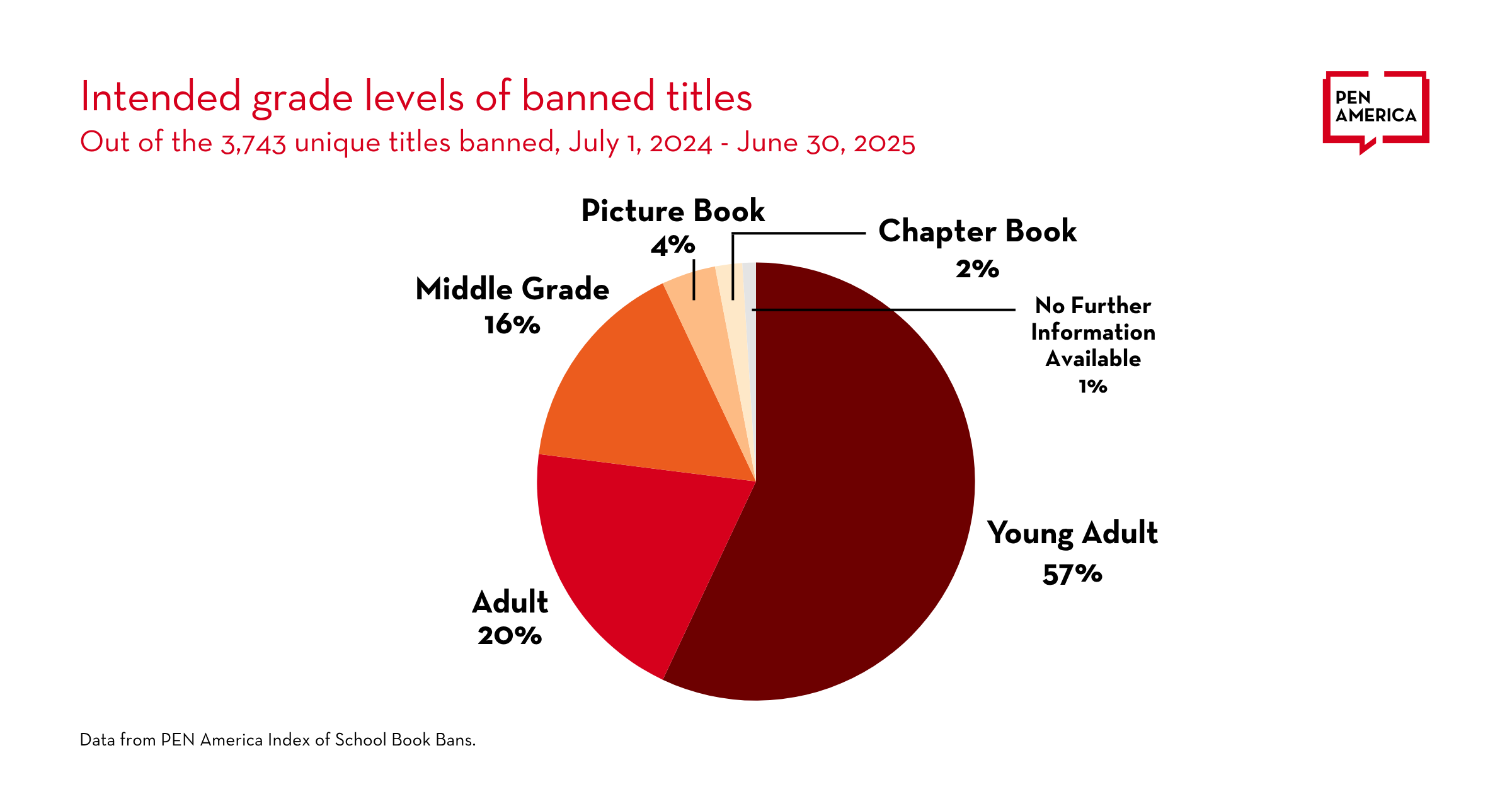
In 2023-2024, 32% of all unique titles banned were adult titles; in the most recent school year, the proportion of adult books decreased to 20% of titles. Instead, bans on “age-appropriate” and age-relevant literature, mainly young adult, middle grade, and chapter and picture books, increased. When we take these opportunities away, we not only lose windows and mirrors, but we lose the impact of literature in the lives of young people—the ability for them to become independent readers and explore worlds on their own.
A Rise in Nonfiction Bans
Without knowledge, we cannot act. Battles over education are battles over freedom.
Jason Stanley, Erasing History: How Fascists Rewrite the Past To Control The Future
The types of banned titles are categorized as fiction, nonfiction, and poetry, and the counts of their removals from public schools across the country spell out the boundaries of the larger attack on public education. While fiction titles still make up the majority of banned titles, the 2024-2025 school year saw a shift in the share of nonfiction and fiction titles compared to the previous year; fiction titles dropped from 85% to 69% of all banned titles, while nonfiction rose from 14% to a startling 29% of all banned titles.
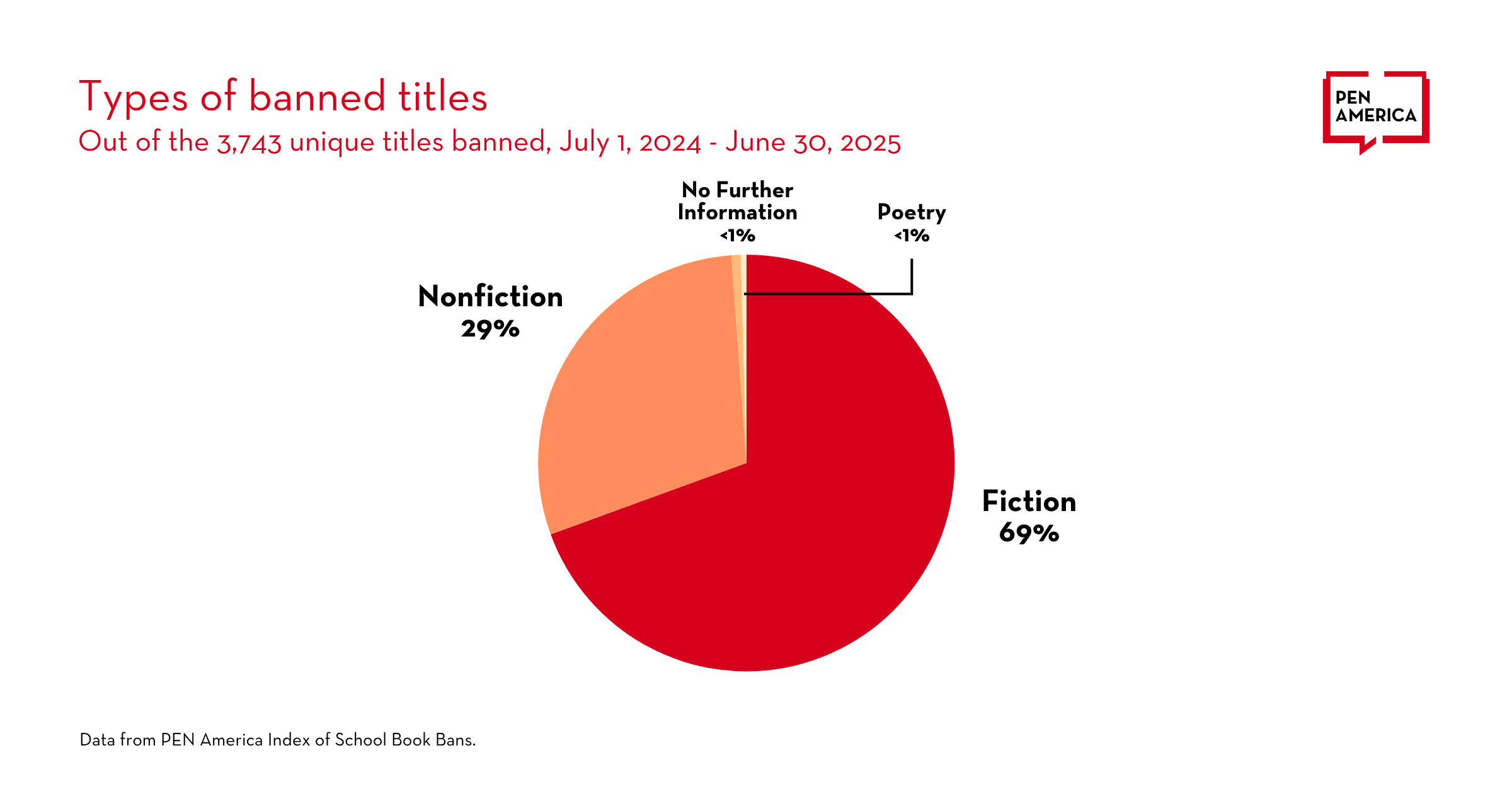
Fiction titles ranged from classics like Fahrenheit 451 by Ray Bradbury to modern bestsellers such as The Hunger Games by Suzanne Collins. Nonfiction titles are wide ranging, from memoirs such as Night by Elie Wiesel to biographies such as RuPaul by Maria Isabel Sánchez Vegara, alongside historical and educational or informational books such as Aztec, Inca & Maya by Elizabeth Baquedano and Challenges for LGBTQ Teens by Martha Lundin.
Over 1,100 unique nonfiction titles were removed from library shelves during the 2024-2025 school year. Nonfiction titles in school libraries and classrooms play a critical part of K–12 education, often recognized as “the gateway to literacy.” For instance, a study on student preferences showed that more than 80% of first graders chose nonfiction when picking out a book to own.
Nonfiction books can help young people develop into readers or serve as resources for research projects. Books in this category often deal with personal, artistic, historical, and educational topics. Exposure to nonfiction increases students’ critical thinking abilities, an important tool in an era where young people are increasingly exposed to dis- and misinformation through social media and AI.
Alongside the increase in nonfiction titles is a cascading increase in several genres impacted by book bans during the 2024-2025 school year. Similar to 2023-2024, realistic/contemporary and dystopia/sci-fi/fantasy remain the dominant genres banned in the 2024-2025 school year. But of note, educational/informational titles grew from 5% of all titles in 2023-2024 to 13% of total titles banned in 2024-2025, or nearly 500 unique titles.
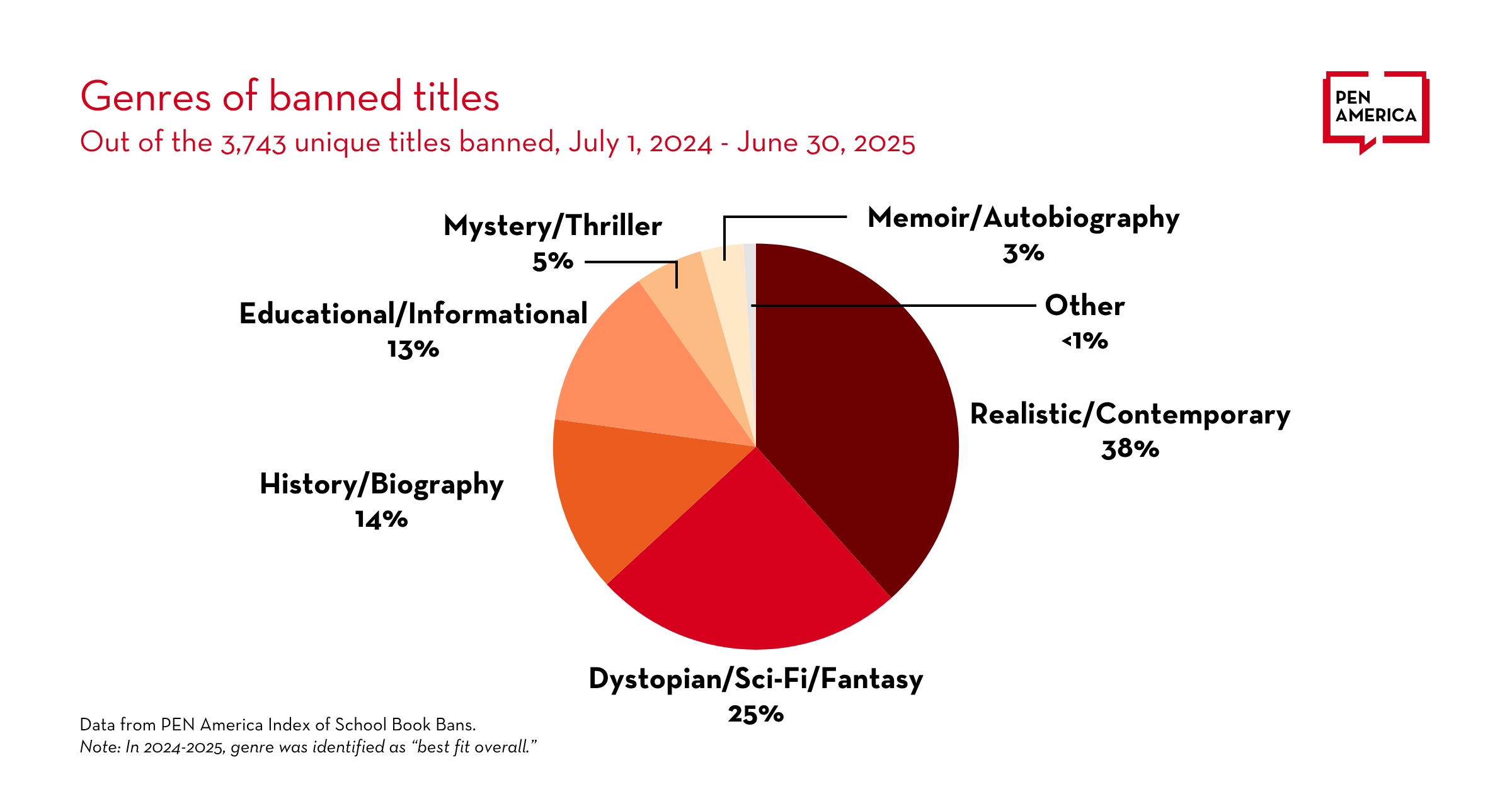
Educational and informational books in our Index are overwhelmingly nonfiction titles, primarily written for students for reference or learning purposes and covering a wide variety of subjects—art, language, politics, geography, identity, puberty, mental health, self-help—and include textbooks, dictionaries, and other reference books. Titles in this category include books like Home Life in Ancient Egypt by Leslie C. Kaplan and A Tour of Your Digestive System by Molly Kolpin and illustrated by Chris B. Jones, as well as the Living Proud! Growing Up LGBTQ books and the Coping Skills Library series.
The increase in educational/informational titles within a larger erasure of nonfiction titles underscores the rising influence of anti-intellectualism in public spheres. The removal of educational/informational titles highlights the growing censorship of information, facts, and accounting of history and events available in public K–12 education across America.
Common Topics in Banned Books
So many teachers and librarians have told me how this book helped their students see beyond their own biases and think about community in a whole new way.
Katherine Applegate, Author
To understand what a book is about, we look at the book’s topics. PEN America tracked 20 themes and topics within the 2024-2025 banned titles.
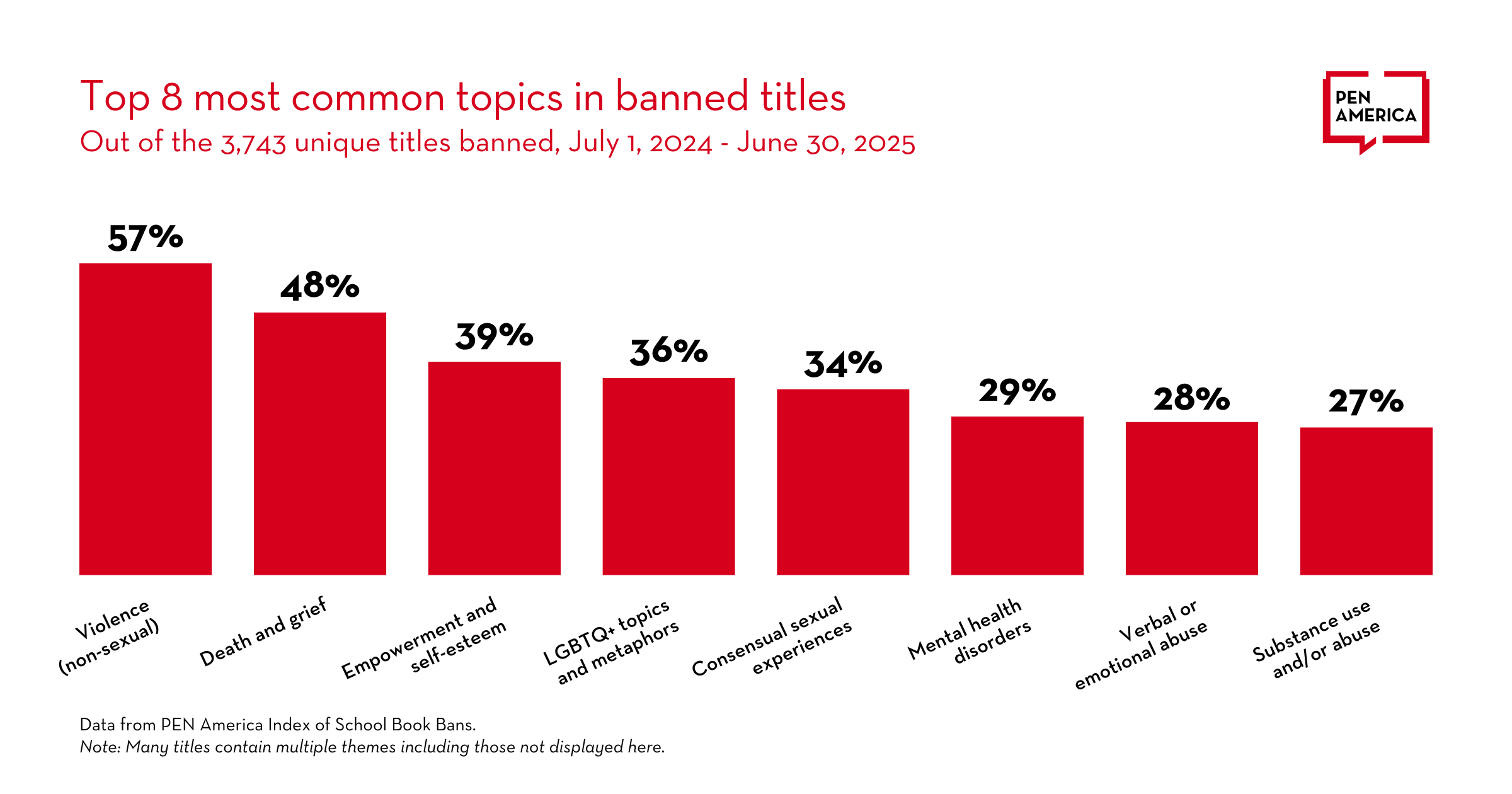
When looking at all titles, three topics rise to the top—nonsexual violence, death and grief, and empowerment and self-esteem.
Over 2,000 titles, or 57% of all banned books, featured themes of nonsexual violence. Books in this category address war, gun violence, natural disasters, domestic violence, human trafficking, slavery and genocide, physical fighting, and more. 48% of titles covered themes of grief and death, the second most common theme across all books.
Books on difficult topics like violence and death encourage debates on morality and the complexities of being human. As students watch characters navigate difficult and sometimes morally gray situations, they can reflect and refine their own understandings of their role in their own world. Removing access to these stories is disempowering and suppresses youth autonomy.
Of note in the 2024-2025 school year, we saw an increase in banned titles that had themes of empowerment and self-esteem. Fictional titles with themes of empowerment include Flor Fights Back: A Stonewall Riots Survival Story by Joy Michael Ellison and illustrated by Francesca Ficorilli and The Moon Within by Aida Salazar. Of the 3,743 unique titles, 39% of them had a theme related to empowerment and self-esteem, an increase from 31% in 2023-2024.
Books about empowerment and self-esteem are notable for encouraging readers to accept themselves and overcome challenges through plotlines that highlight the importance of support systems. This theme can also be represented in titles through arcs exploring determination, self-confidence, bravery, passion, empathy, and acceptance. Stories that empower readers through plotlines and literary themes serve as invaluable resources that young people might not encounter elsewhere. To remove these books from classroom and library shelves means revoking access to books that students may rely on for personal and emotional development.
Further information on LGBTQ+ themes and metaphors and consensual sexual experiences can be found below.
Commonly Banned Topics in Nonfiction Titles
To further examine the rise of nonfiction, we looked at the themes and topics represented within nonfiction titles. Of the 1,102 nonfiction titles banned, 52% contained themes of activism and social movements, the most commonly banned topic within nonfiction titles.
These are real stories and experiences erased by the censorship movement. Whether #WomensMarch: Insisting on Equality by Rebecca Felix or IntersectionAllies: We Make Room for All by Chelsea Johnson, LaToya Council, and Carolyn Choi and illustrated by Ashley Seil Smith, this literature is crucial in the education of young people. These books can encourage readers to challenge the status quo and resist injustice.
27%
of all unique banned titles featuring themes of activism and social movements
52%
of all banned nonfiction titles featuring themes of activism and social movements
This increase should not be a surprise, given the increased crackdown on activism and free speech by the federal government over the last year. These themes encourage young people to question authority and societal inequities, confront injustice in their communities, and participate in social changes to address disparities in the world around them. Suppressing these themes sends a message of discouragement and the need to maintain the status quo.
Erasing Stories, Erasing People
The function of literature is to ask questions we don’t know the answers to; to have the wild and wonderful horrible world laid bare before us; to see ourselves, to see each other; and to broaden our minds past the confines of the geography we were born to. Literature is freedom.
Maggie Tokuda-Hall, Author
Book bans are about not only the books but the stories of the people inside their covers. Literature is used to convey many people’s lived experiences—in both fiction and nonfiction. Bans on diverse books remove integral narratives from library and classroom shelves, eliminating marginalized people’s stories from K–12 libraries and classrooms across the country. This is detrimental. Representation in literature not only fosters interest and love of reading, as it provides a mirror to identity, but it allows, as Dr. Rudine Sims Bishop and others have suggested, a “sliding glass door” for exploration of unknown worlds.
Identities in Book Bans
Tell your story. Because if you don’t it could be wiped out… What we did. What we fought for. Our history. Who we are. They won’t teach it in schools. They don’t want us to have a history.
Abdi Nazemian, Author
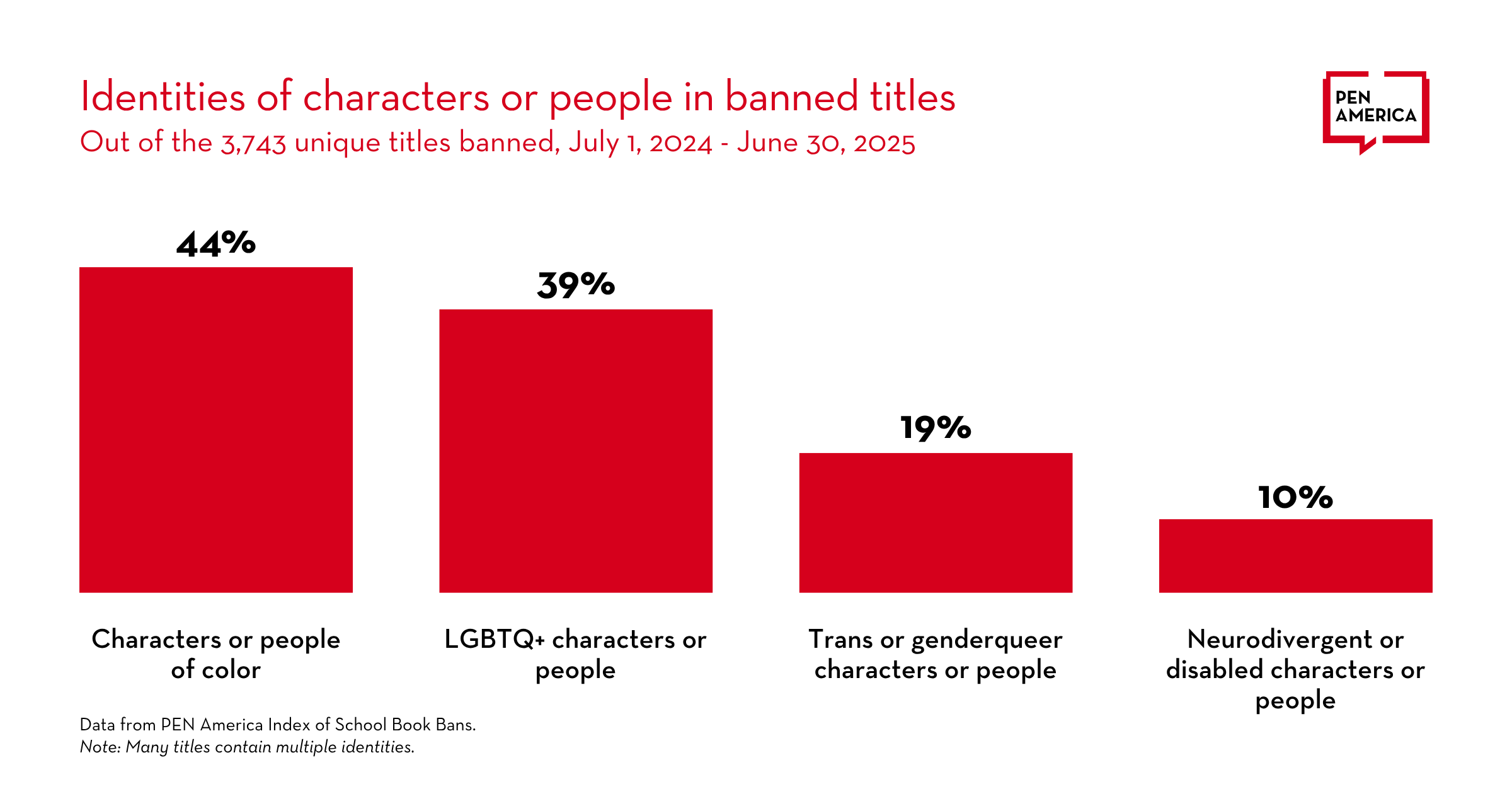
Titles featuring marginalized characters or people and communities, especially the LGBTQ+, BIPOC, and neurodivergent and disabled communities, continued to be heavily targeted in the 2024-2025 school year.
Characters or People of Color
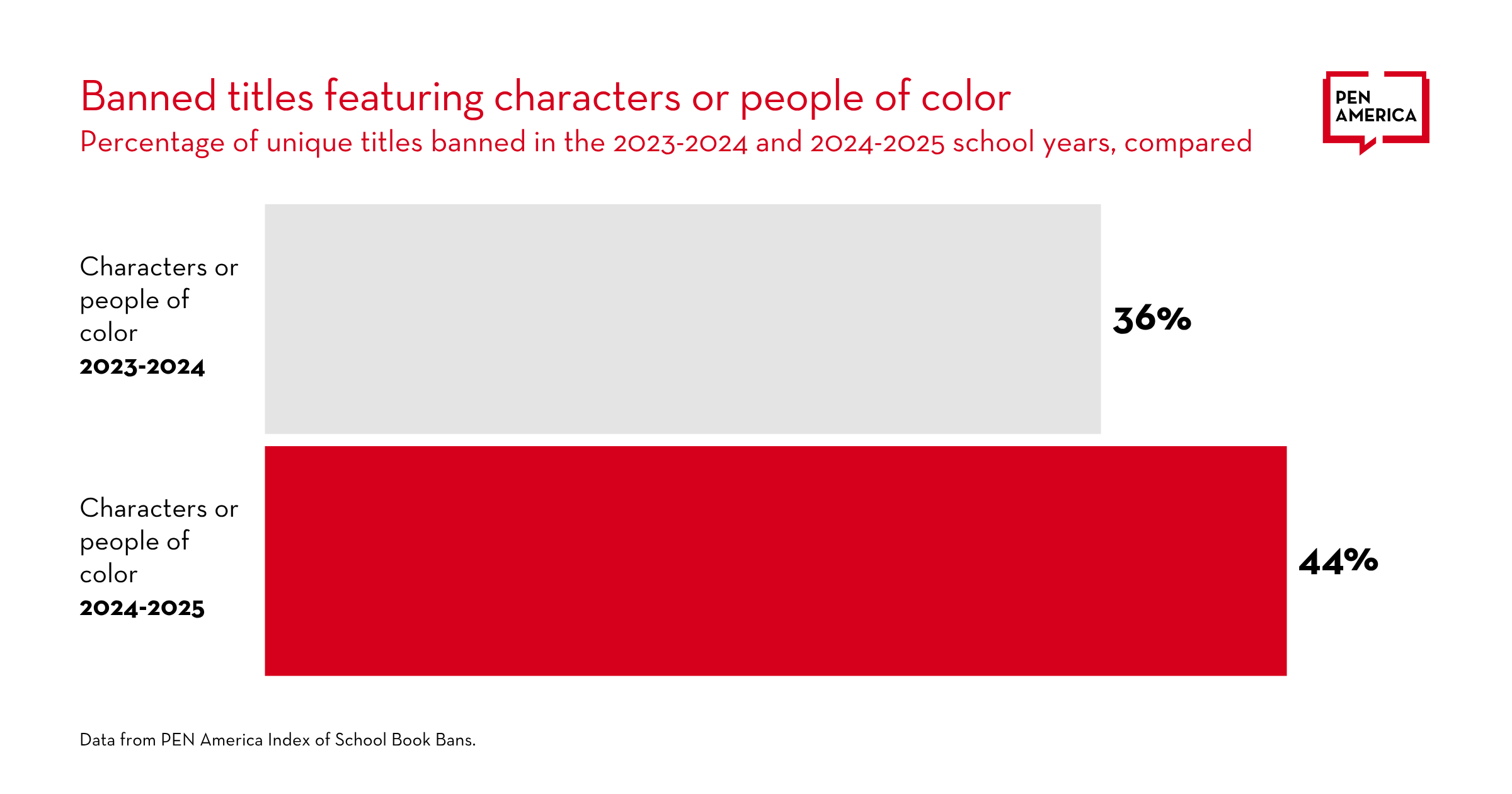
Of the 3,743 unique titles banned this year, 1,664, or 44% featured characters or people of color. This percentage is nearly half of all banned titles during the 2024-2025 school year, which is the largest percentage that PEN America has ever reported in this category.
In 2024, early childhood educators Sanjuana Rodriguez and Sandra Osorio published a study of banned and challenged Latine picture books. In it they concluded that “this is especially important for Latine and Black children because books that reflect their lived experiences support positive racial identity development as they shape their perceptions and understandings of who they are.” The removal and erasure of these stories and others intended for older readers is having a deeply harmful impact on the mental health and consequently the educational outcomes of students of color.
The disproportionate and significant increase in bans on titles with characters of color corresponds with the larger attacks on marginalized communities. Campaigns against diversity, equity, and inclusion have contributed to restrictions and removals on books with people of color and mirror efforts to suppress curriculum on Indigenous history, Black history, Asian American and Pacific Islander stories, and Latine and Hispanic contributions. These efforts continue to downplay the horrors of American colonialism, imperialism, and oppression domestically and abroad. Similarly, this suppression frequently erases the contributions of people of color to progress and innovation in the United States.
Race and Racism, Immigration and Refugee Stories, and Incarceration or Negative Interactions with Police
I think it’s important to tell the stories [of immigrants] right now because another story is being told about immigrants, a very dehumanizing story, a very silencing story.
Edwidge Danticat, Author
Overlapping with stories that simply feature marginalized people, a portion of banned titles also address issues and themes relating more commonly to the experiences of those within BIPOC communities, mainly surrounding race and racism, immigration, and police reform and incarceration.
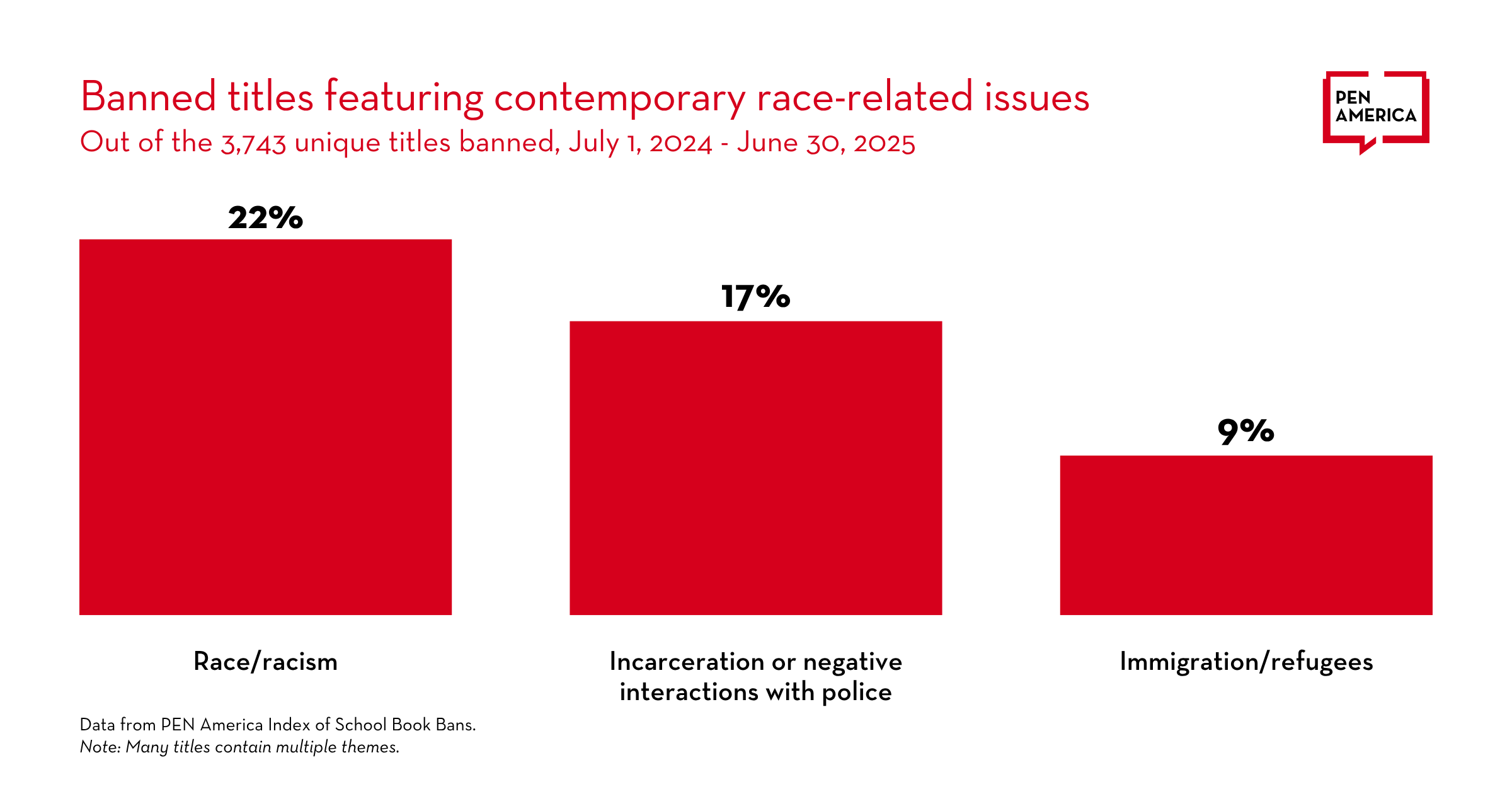
Among titles banned in the 2024-2025 school year, 22% or 805, covered race and racism, such as A Raisin in the Sun by Lorraine Hansberry; 17% or 631, depicted incarceration or negative interactions with police, such as Little Fires Everywhere by Celeste Ng; and 9% or 342 titles included immigration and refugee experiences, such as Santiago’s Road Home by Alexandra Diaz.
At such a pivotal moment in the United States, conversations about incarceration, law enforcement, and race and racism are necessary as we navigate the intersections of immigration, ICE, and police violence. Contemporarily, immigrant children are being isolated from classrooms across America as they go into hiding for fear of incarceration at the hands of federal agents. The removal of these themes illustrates the deliberate suppression of these timely and pertinent issues. These books matter to children and young people across this country; their removal poses an additional harm on some of the most vulnerable in our communities.
LGBTQ+ Characters or People
More than a third of all banned titles of the past school year included books about the LGBTQ+ community. Of the 3,743 unique titles banned in 2024-2025, 1,448, or 39% featured LGBTQ+ characters or people. This is a sharp increase from 25% of the titles in the prior school year.
The number of banned titles with transgender or genderqueer characters or people has also escalated. In 2023-2024, 7% of all banned titles featured trans or genderqueer characters or people. In 2024-2025, that number nearly tripled, to a startling 19%. Banned titles featuring transgender or genderqueer characters or people include young adult fantasy adventures like Cemetery Boys by Aiden Thomas and memoirs like that of actor Elliot Page, Pageboy.
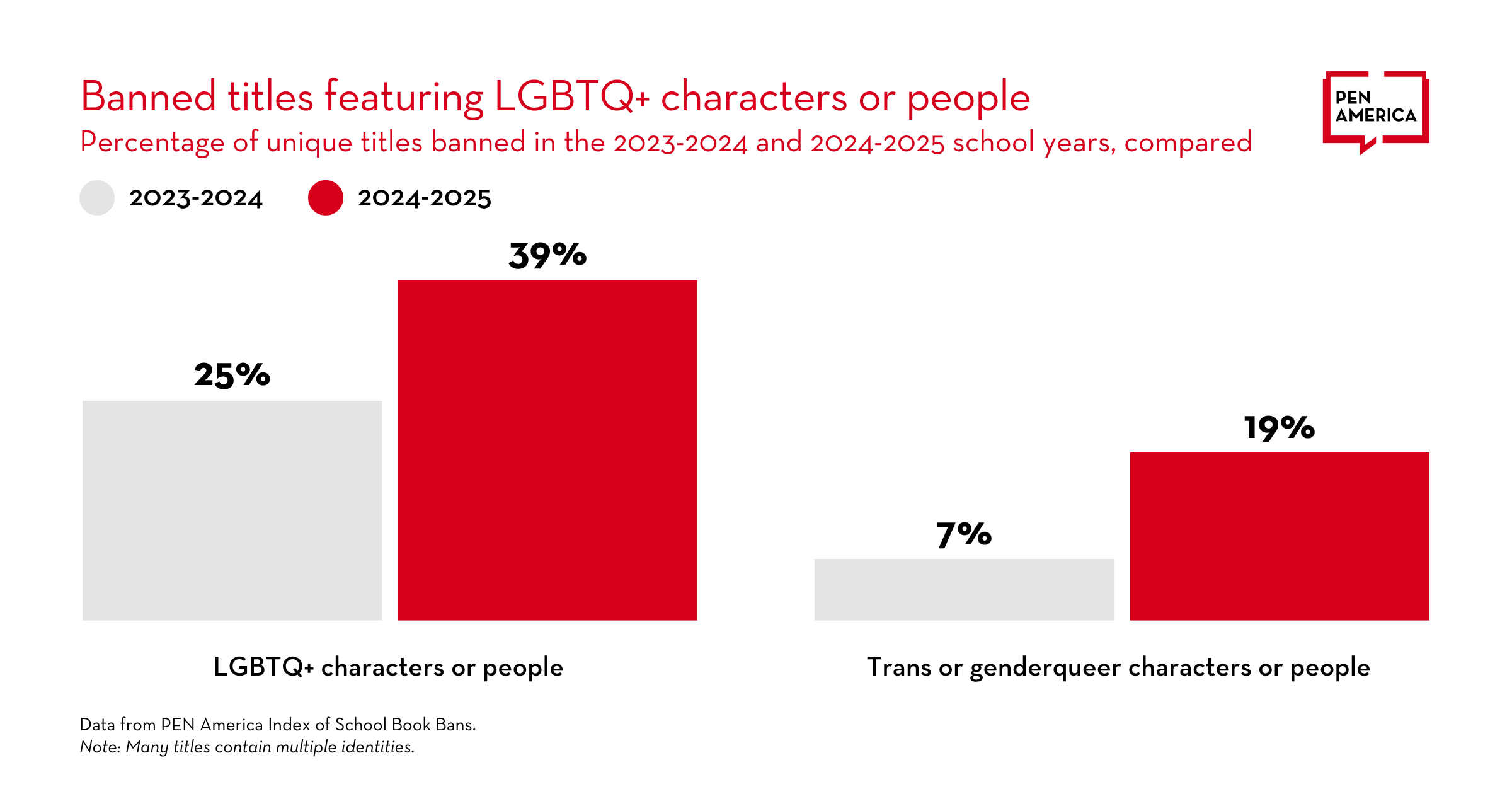
According to the Williams Institute, 1% of those aged 13 and older identify as transgender in the United States, yet nearly 20% of the literature banned in 2024-2025 featured a character or story of a transgender or genderqueer person. The heightened attack on the literature representing the LGBTQ+ community, and especially trans and genderqueer identities, reflects ongoing attempts to erode civil rights of members of this community in the United States.
LGBTQ+ Themes and Metaphors
I hope ‘Red’ will inspire reflection about the subtle ways children become mislabeled, judging children based on their successes rather than their failures, and the unmitigated joy of finding one’s place in the world.
Michael T. Hall, Author
Red: A Crayon’s Story, according to Michael Hall, is a story about the courage to be yourself, no matter who you are. It also is frequently banned because some people interpret it as a specific allegory for trans identity. This is why, in addition to tracking LGBTQ+ characters and people in banned books, we also look at LGBTQ+ metaphors. This category is important because it identifies content that may be interpreted as LGBTQ+ content or has parallels to LGBTQ+ experiences or topics, such as gender nonconformity or uniqueness, whether or not the books are explicitly about LGBTQ+ people. Books in this category include titles like And Tango Makes Three by Justin Richardson and Peter Parnell and illustrated by Henry Cole and My Shadow Is Pink by Scott Stuart. It can also include topics related to LGBTQ+ history, like the picture book biography by Lisa Robinson Were I Not a Girl: The Inspiring and True Story of Dr. James Barry.
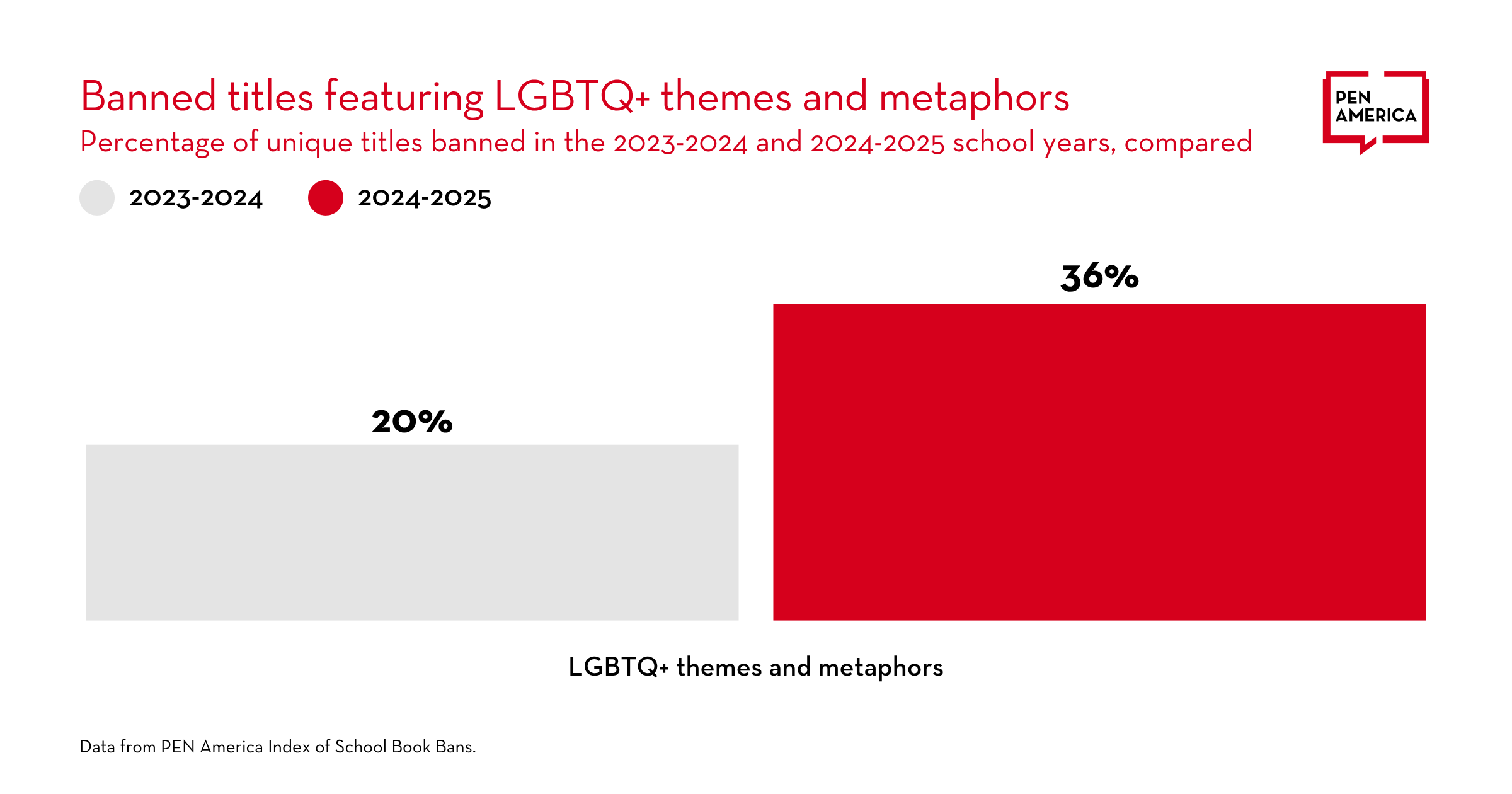
As direct representation is removed, so too are metaphors and allusions to LGBTQ+ identities and themes in books for young readers. Access to books with LGBTQ+ topics or metaphors can be an essential lifeline for LGBTQ+ students seeking community, validation, and representation. Children’s first interactions with these topics can be educational, teaching young people through literature to accept themselves and others while respecting differences.
Neurodivergent and Disabled Characters or People
As demonstrated, attacks on diverse literature impact a host of experiences and identities. In 2024-2025, 377, or 10% of the banned titles detailed the experiences of characters or people who are neurodivergent or have a physical, learning, and/or developmental disability. These banned titles frequently included stories about confidence, self-esteem, or experiences with ableism. Titles in this category include a range of classics, such as To Kill a Mockingbird by Harper Lee and I Never Promised You a Rose Garden by Hannah Green. They also include modern classics like Push by Sapphire, Everything, Everything by Nicola Yoon, and A Boy Called Bat by Elana K. Arnold. Representation of all students in classroom literature validates their experiences, and these titles also help able-bodied and neurotypical students to better understand their neurodivergent and disabled peers and loved ones.
It’s Not Porn: Sexualizing Stories, Bodies, and Violence
There’s a discrepancy between the titles impacted by book bans and the justifications made to ban books. Book banners have long cited “pornography” and “sexually explicit” material in literature to justify book challenges. Claims that these books contain “explicit” or “obscene” content grossly misrepresent the materials.
Sex-related content informs young people about consent, bodily autonomy, and models of healthy (sexual and nonsexual) relationships. Research shows that information about consent and sexual health has an overwhelmingly positive impact on young people, decreasing rates of sexual violence through an emphasis on self-advocacy and warning signs of abuse and decreasing rates of STIs and teen pregnancy through information about safer sex practices. Under the misguided notion that there’s pornography in schools, efforts to ban books sweep up titles with any sexual content.
Books with sexual violence and abuse themes have also been a part of the swath of books targeted by the book banning movement as containing “pornographic” or “sexually explicit” content. Accusations that books with sexual violence are pornographic are a mischaracterization of their content and utterly disregard the experiences of survivors and those who see themselves in these books.
Banning of Sex-Related Content
If sexuality is a part of [a character’s] journey and part of the story, then of course I’m going to write about it … That’s why there is sexuality in my books: because it is part of life.
Malinda Lo, Author
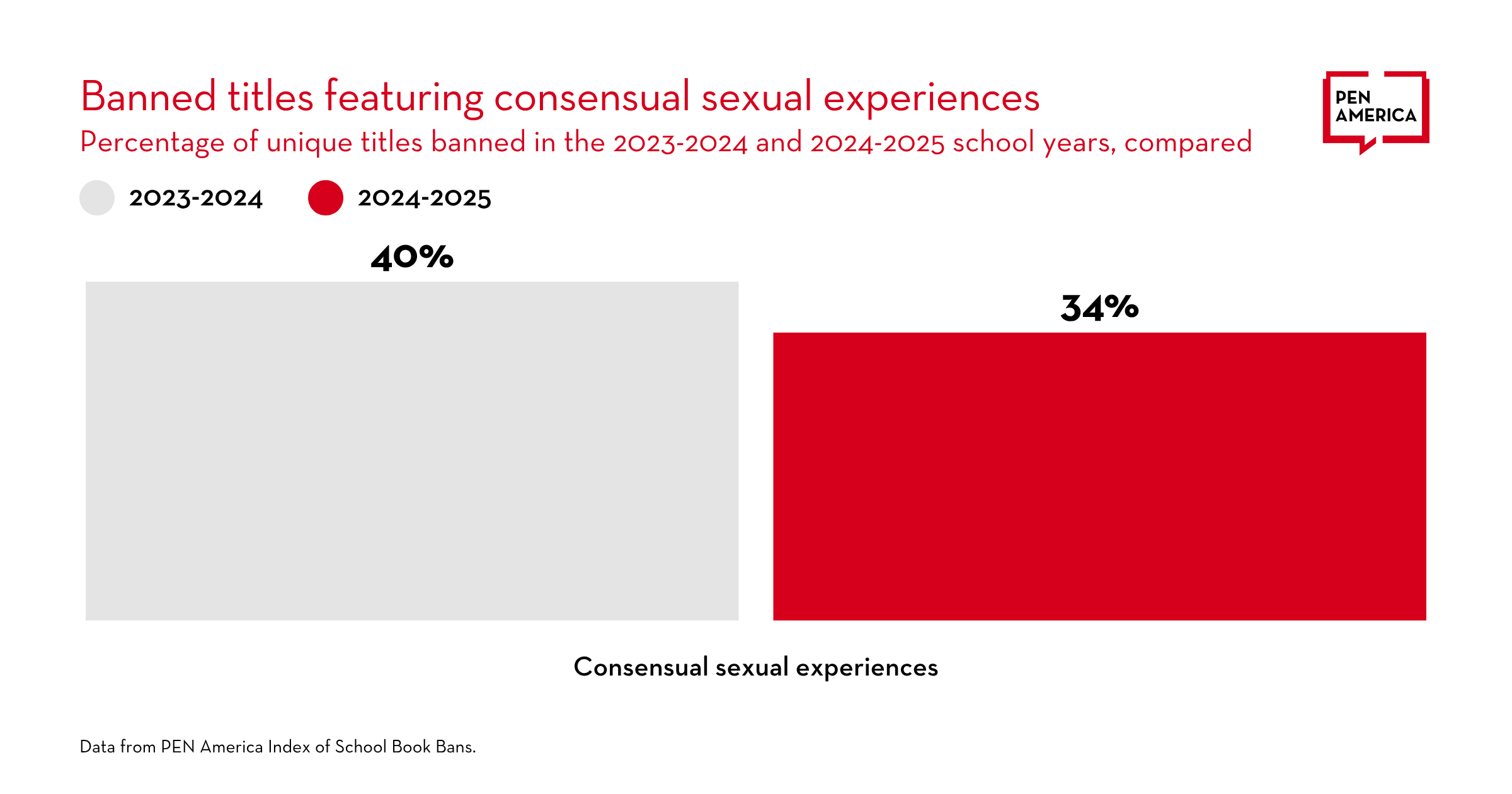
Of all unique titles banned during the 2024-2025 school year, more than a third (34% or 1,270) featured consensual sexual experiences, compared to 40% or 1,680, during the 2023-2024 school year. This decrease emphasizes how broad attacks on “sexually explicit” materials sweep up all kinds of books—the majority of which have no mentions of sexual experiences whatsoever.
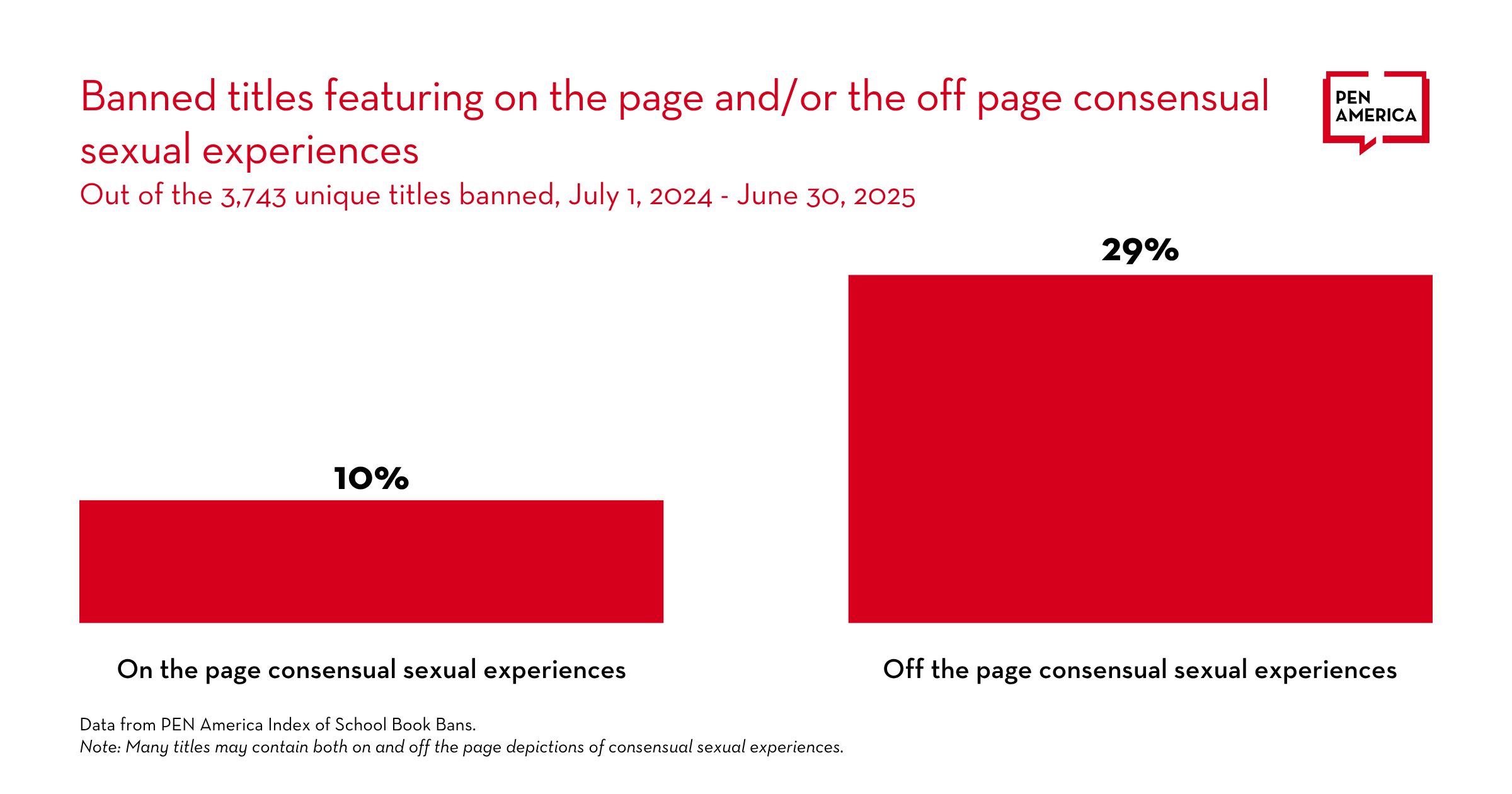
We also examined consensual sexual content through the lens of “on the page” and “off the page” scenes and descriptions. Off-the-page scenes are those in which the experience happens beyond the narration, often leaving the experience to a reader’s imagination through implied references or a fade-to-black approach. Books with on-the-page sexual experiences between characters, however, contain more descriptive scenes. Sometimes titles have both. In our analysis, only 10% of titles banned in 2024–25 (or 377 of 3,743) actually contain on-the-page consensual sexual content, suggesting a widespread oversexualization in the rhetoric that is used to justify banning these books.
Lastly, titles with sexual health and puberty education composed 8% of all unique banned titles, which was double the proportion from the previous school year (4%). Books with sexual education themes include titles like You Know, Sex: Bodies, Gender, Puberty, and Other Things by Cory Silverberg and illustrated by Fiona Smyth and The Little Black Book for Girlz: A Book on Healthy Sexuality by St. Stephen’s Community House.
The Sexualization of Nudity
It just seems such a shame. How is it hurting someone, for goodness’s sake? Everybody sees themselves naked in the mirror.
Don Nardo, Author
The cries of “pornography” or “sexually explicit material” in schools and in state legislation targeting sexual content have led to a large number of books with any nudity being banned. Of books banned during the 2024-2025 school year, 293, or 8% of all unique titles included nudity (informational or artistic).
Books about art and historical books about ancient civilizations such as Greece, Egypt, and more have been banned for containing nudity. As have picture books such as Draw Me a Star by Eric Carle, which was banned in Florida, Iowa, and Texas.
The mere presence of a nude body is not inherently sexual or pornographic. Nudity can be used in instruction around anatomy or biology, education about historical artifacts and works of art. It can also encourage conversations around bodies, consent, and artistic license. Under the guise of removing all “explicit” or “inappropriate” material, students’ access to important knowledge about sex, bodies, and health is being taken away. As school districts struggle to comply with overly vague state laws, books with any reference to sexual experiences, puberty, and sexual health information, as well as mere depictions of naked bodies, are all being swept off the shelves.
Sexual Violence is Violence: Depictions in Literature
I’ve watched with dismay as the sexual violence I experienced as a child has been labeled pornography, dismissed as fiction, called part of a ‘pedophile agenda’.
Julia Scheeres, Author
In our content analysis, we make a distinction between consensual sexual experiences and nonconsensual sexual violence, which includes rape, sexual abuse, and sexual assault. People who are using rhetoric of sexual explicitness to attack literature far too often ignore this distinction and equate sexual violence with sexual content.
In 2024-2025, 724, or 19% of all banned titles contained sexual violence. According to RAINN, 1 in 9 girls and 1 in 20 boys under 18 experience sexual abuse or assault. With so many of these titles banned since 2021, it is possible that some young people who have experienced sexual violence no longer have access to books that could help them. Young people who have experienced sexual violence should be able to find literature to which they relate and that can help them through that experience, instead of seeing their own pain and abuse mischaracterized and censored. Books containing experiences of sexual violence include The Nickel Boys by Colson Whitehead, winner of the 2020 Pulitzer Prize for Fiction, set in a 1960s Southern juvenile reform school, and Laurie Halse Anderson’s memoir Shout, a call to action for sexual abuse and trauma survivors in the wake of the #MeToo movement. Such stories are not sexual but violent—and they have important value for the students who seek them out and want to learn from them. To suggest otherwise distorts and ignores the true content of these titles, the intentions of their authors, and the experiences of their readers.
Conclusion
The public has only just jumped on board with celebrating inclusive books and truly supporting them with dollars and library checkouts. To have those same books and identities threatened again, and so quickly, is disturbing. I am worried for our democracy. I worry for our children. I worry for every person whose identity is being censored.
Charlotte Sullivan Wild, Author
Book bans withhold knowledge from young readers, erase stories of the past and present, and reinforce growing distrust in public institutions. Reducing complex, diverse stories to “sexual content” to justify censorship is both inaccurate and harmful to everyone—readers, educators, librarians, and community members alike. Removing books that feature people of color and LGBTQ+ people and themes sends harmful messages to students about belonging and restricts opportunities for all young people to both see themselves reflected in books and empathize with the experiences of others. Censoring away nonfiction titles on topics relevant to young readers, like social movements and activism, puts extreme limits on the information and knowledge detailing real events and real people.
As the literacy crisis ripples across the country, we know learners are more likely to engage with literature that piques their interest. Teachers report that their students are more enthusiastic readers when diverse books are available to them, whether they are reading fiction and nonfiction titles for pleasure or seeking reference books for educational purposes.
During a pivotal time in the United States, the ongoing disempowerment of historically marginalized communities, the distrust in public schools and expertise, and the normalization of book bans and educational censorship illustrate conditions long associated with the rise of authoritarianism. At what point do we decide that the erasure of literature, stories, and histories and the disdain for expertise have hit a breaking point?
The fact is, educational censorship in our schools affects us all. As the author and senator Paul Wellstone once said, “We all do better when we all do better.” H.R. 7661, a federal censorship bill introduced in February, must be stopped. Bans on books in schools and libraries across the country must not go on. The freedom to read is for all of us to uphold. Join us now in speaking for books, readers, authors, and freedom.
Methodology
PEN America tracks book ban cases occurring in public school districts across the United States. A ban case represents the banning of a title in a school district. A title is banned when an action is taken against a book based on its content, either as a result of parent or community challenges or administrative decisions or in response to direct or threatened action by government officials. A book ban leads either to the complete removal of a book’s availability to students or to restricted or diminished access to a book. Multiple copies of the book may be banned across schools in the district, but they will be featured only once as a ban case. The banning of a single book title can mean that anywhere from one to hundreds of copies are pulled from libraries or classrooms in a school district, and often, the same title is banned in libraries, classrooms, or both in a single district.
We also track the banning of unique titles. If the same book is banned in 10 school districts, that would count as 10 bans (10 book ban cases) but one unique title. The data presented in this report is based on total unique titles banned during the 2024-2025 school year, rather than total cases of book bans. This report examines 3,743 unique titles extracted from our Index of School Book Bans, which records 6,870 book ban cases during the 2024-2025 school year.
Using a team of staff researchers, expert consultants, and author volunteers, each unique title was reviewed across 37 variables, primarily the type of book (e.g., genre, age level) and content within the title (e.g., LGBTQ+ characters or people, sexual experiences between characters). Final coding was reviewed, cleaned, and analyzed by PEN America’s research team.
A small reduction (9 titles) in our initially reported count of unique banned titles (3,752) occurred in the process of analysis because of incidental duplicates. This did not impact the total number of book ban cases reported in the 2024-2025 school year (6,870).
For more information about our standard methodology and definitions, please visit our 2024-2025 report, The Normalization of Book Banning, our frequently asked questions page, and the PEN America Index of School Book Bans – 2024-2025.
Acknowledgements
This report was written by Freedom to Read Program experts Tasslyn Magnusson, senior advisor, McKenna Samson, program manager, and Yuliana Tamayo Latorre, program assistant. Data analysis was reviewed by Sabrina Baêta and additional support was provided by Madison Markham, program coordinator. The report was reviewed and edited by Kasey Meehan, director, freedom to read and Jonathan Friedman, Sy Syms managing director, U.S. Free Expression Programs.
This brief details a comprehensive analysis of the content and themes present in banned books. We thank the following individuals for providing key support in coding the content and themes of banned titles: Octavia Driscoll, Daniel Shank Cruz, and Sanobar Wilkins.
PEN America is grateful for support from the Endeavor Foundation, the Henry Luce Foundation, and the Long Ridge Foundation, which made this report possible.
We also thank key partners in this work, including Authors Against Book Bans, EveryLibrary and EveryLibrary Institute, American Library Association, the Florida Freedom to Read Project, Let Utah Read, the Texas Freedom to Read Project and many more. This work is deeply informed by Censorship News Reports from Kelly Jensen at Book Riot.
Learn More
-
Facts & Fiction
The content of these books that are disappearing speaks volumes about the political and cultural attack on public education across the U.S.
-
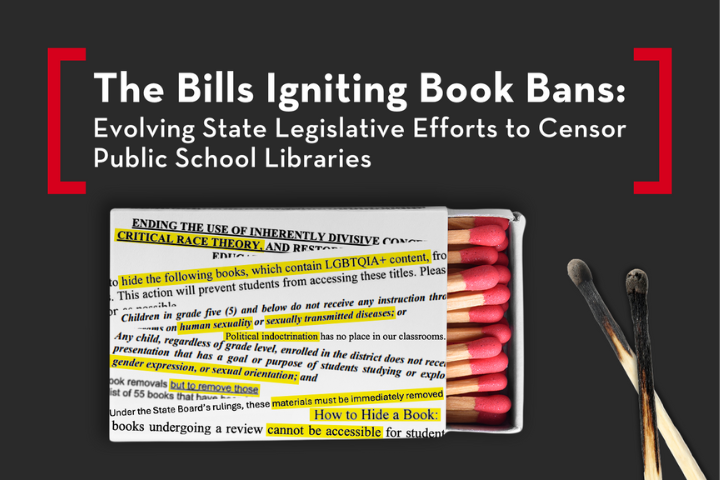
The Bills Igniting Book Bans
Learn more about how state laws are propelling book bans at the local level and the impact they are having on schools and students.
-
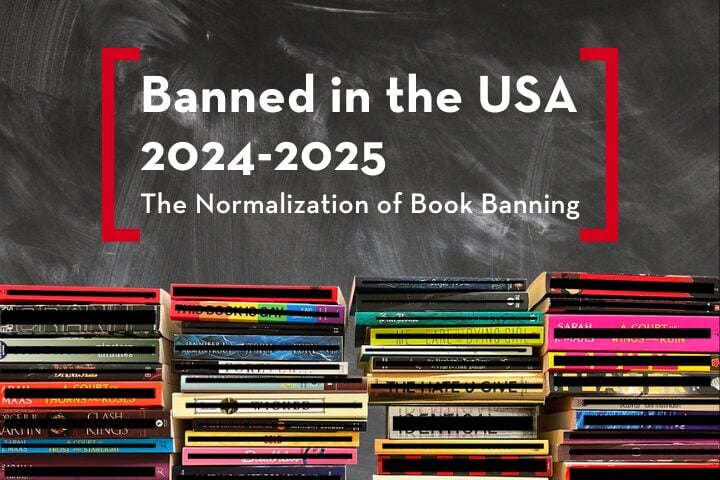
The Normalization of Book Banning
This report offers a window into the complex and extensive climate of censorship between July 1, 2024 through June 30, 2025.
-
The Blueprint State
A wave of education laws in Florida has had a detrimental impact on the state’s schools, chilling the climate for teaching and learning.
-
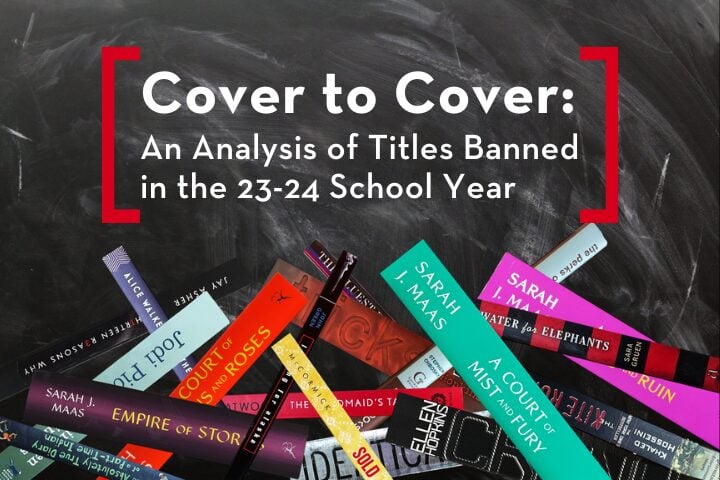
Cover to Cover
Introduction In the 2023-2024 school year, there were more than 10,000 instances of banned books in public schools, affecting more than 4,000 unique titles. These mass book bans were often the result of targeted campaigns to remove books with characters of color, LGBTQ+ identities, and sexual content from public school classrooms and libraries. As book…
-
Banned in the USA: Beyond the Shelves
For the last three school years, PEN America has recorded instances of book bans in public schools nationwide. In that time, efforts to erase certain stories and identities from school libraries have not only intensified; book bans have become a bellwether of the chilling of public education writ large. As this report on the 2023-24…